Surviving the Summer:
When the School Bells Stop |
For many families, summer looks wonderful from the outside. Long days, no homework, freedom from alarm clocks, and nothing but fun in the sun. But if you're raising a neurodivergent child, you may already know that "freedom" can feel less like a gift and more like a cliff edge. The loss of school-day structure doesn't just disrupt schedules. It can disrupt everything else in your daily life. |
Children who thrive on predictability, such as kids with ADHD, anxiety, autism, sensory processing differences, or mood disorders, often rely on the school routine as an invisible scaffolding. When that scaffolding disappears in June, the result can be meltdowns, sleep disruption, emotional dysregulation, and exhaustion for the whole family. You are not doing it wrong. This is just genuinely hard. The good news is that structure doesn't have to mean rigidity. It can simply mean predictable enough. Even a loose rhythm such as waking up, moving around, eating, creating, resting, and connecting gives the nervous system something to lean on. You don't need a color-coded binder, you need a few anchors in the day that your child can count on.
|
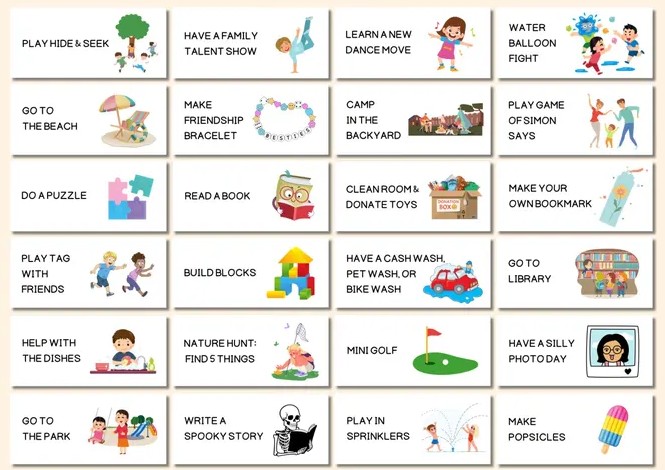
Co-create a "summer menu" with your child. Work together to create a short list of activities in each of those categories that they can choose from each day. Having options within a structure gives kids a sense of safety and predictability. When they know they don't have to fear the unknown or the unexpected, predictability can help to keep the anxiety, distress, and escalation away. |
Transitions between activities, between home and an outing, between summer and back-to-school, are their own challenges. Give warnings early and often. "In ten minutes we're leaving" means something different to a child who struggles with time blindness than it does to you. Visual timers, simple checklists, and consistent transition cues (a song, a phrase, a signal) can dramatically reduce the friction around these moments. There's also the emotional weight that summer can carry for kids who miss the social rhythm of school, who struggle with boredom, or who are quietly dreading the fall. It's worth naming those feelings out loud, even if your child can't yet. "Some kids feel kind of lost without school. Does any part of that feel true for you?" You don't have to fix the feeling. You just have to make room for it. At CMHRC, we know summer can be one of the most exhausting seasons for caregivers. We also know you're already doing more than enough, even on the days that don't look like it. Our resources are here for you all year long, not just when school is in session. Explore tools and programs designed to support your family through every season, including the unstructured ones.
|
|
Stay Cool This Summer: Simple Strategies for Hot Days |
June 17th, 2026 7:30-8:30 PM Eastern Time |
Cool, cool, cooling for the hot, hot summer. Families and practitioners alike, come learn how to use, all year long, simple at home cooling strategies to manage mental health issues like symptoms of bipolar and “FOH”. We’ll go over how to build a plan to integrate these thermoregulation techniques into daily life. These strategies go a long way in reducing overheating and making sleep, moods, and all of daily life more manageable. |
Mental Health in the Age of Climate Crisis: Implications for Clinical Practice |
|
Wednesday, June 24th 5:00-6:30 pm eastern time
|
One of the major threats of climate change is rising heat and the complications this has for those who live with mental illness. Stigma around mental illness causes many of the people who are most at risk to be isolated, economically, and socially marginalized leading to greater risk to their mental and physical health. Join us for a deep dive into the impact of climate change on mental health, mental illness, and the future of mental healthcare needs.
|
Register before the event begins and receive a 35% discount off the regular Live CE price:
use coupon code EARLYREG |
|
I Can Fix This, and Other Lies I Told Myself While Parenting My Struggling Child by Kristina Kuzmič
|
June 21st, 2026 - 8:30pm Eastern Time |
When author Kristina Kuzmič started to see signs that her otherwise sunny, resilient teenage son was struggling, she was sure a few simple fixes could right the ship. But over the following months, the issues her family faced became more nuanced, complicated, and more pervasive than she could’ve predicted. Despite her best efforts, Kuzmič had internalized a set of obligations, ideas, and unrealistic standards from parenting culture and social media that left her unprepared to guide her child when he needed her most. Kuzmič’s new book debunks ten “parenting truths” that kept her in crisis, and delves into her insecurities and the mistakes she made to reveal invaluable lessons and transformative approaches that worked. Kuzmič’s journey calls to parents who have felt the instinct to say “I can fix this” in situations where good intentions far exceed our abilities to enact change.
|
Children's Mental Health Month Fundraiser Update |
Thank you for your generosity during Children’s Mental Health Awareness Month. All of us at CMHRC, are deeply moved by the commitment of our CMHRC Family of Donors. If you missed the opportunity to participate in our spring fundraiser, not to worry! Gifts can be made year round through our safe and secure online giving platform, on our website, by clicking the link below, or by mailing a contribution to:
|
CMHRC Gift Processing | 111 Hekili St. Suite A-600 | Kailua, HI 96734 |
Thank you for your generosity, your compassion, and for being an essential part of the CMHRC community. |
|